PTSD: Understanding, Healing, and Reclaiming Your Life
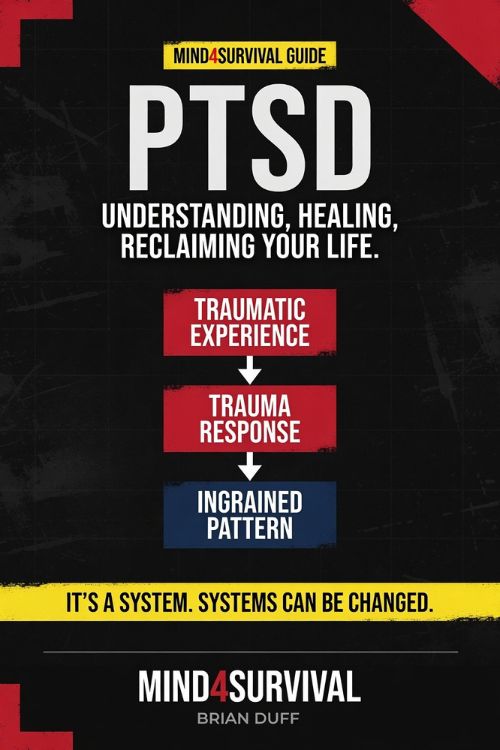
TL;DR—PTSD isn't weakness and it isn't permanent. It's a system: a traumatic experience creates a trauma response, and repetition wears that response into a pattern. Because it's a system, it can be changed. Treatment works for most people who do the work. The rest of this page is what I've learned about how.
I was at the top of my profession when I hit rock bottom.
Lifeguard. Army Ranger. Firefighter-paramedic. Over two thousand days managing high-threat security overseas. I built a career on being the guy who stayed calm when other people couldn't.
And then I couldn't drive to work.
Not because I was weak. Because my nervous system had learned something in 2006 and would not unlearn it on its own.
This guide is what I know about PTSD—what it is, how it works, what the symptoms actually look like, and what to do about it. Some of it comes from the research. Most of it comes from having lived in it and dug my way out.
The most important thing on this page: recovery is possible. You do not have to stay like this forever.
What PTSD Actually Is
PTSD is a normal reaction to abnormal events.
It's a real, measurable brain and body response to trauma that never got processed. The VA's National Center for PTSD defines it as a mental health problem that some people develop after experiencing or witnessing a life-threatening event.
The word that matters in there is some. Not everyone who goes through trauma develops PTSD. And the ones who do aren't broken, weak, or defective. They got a normal response to something that was not normal.
Trauma Is Trauma
Here's what I've come to understand, and it's the thing most people get wrong.
- Trauma is in the eye of the beholder. What wrecks one person barely registers for another. That's not a character flaw on either side. It's how the human nervous system works.
- Trauma does not discriminate. It's an equal-opportunity traumatizer. It doesn't care how tough you are, what your job is, or how much you've handled before.
- Adult trauma is often rooted in childhood trauma. The thing that took you down as an adult usually found a crack that was already there.
That last one is worth sitting with, because the research backs it up hard. A study of public safety personnel—cops, firefighters, medics, dispatchers—found that 79% reported at least one adverse childhood experience, and 44% reported two or more. The general population runs around 64%. We don't wander into these jobs by accident. A lot of us are compensating for something, and the job just gives it somewhere to go.
Mine was an explosive, emotionally unavailable mother, and a lifetime of proving I could handle anything.
The Trauma System
All the "craziness" that comes with PTSD is not craziness. It's a system.
It runs like this:
Something happens. Your nervous system produces a response. Then that response gets reinforced—every time a sight, a sound, a smell, or a feeling matches the original, you run the pattern again. Over and over, until the pathway is worn deep and it fires without permission.
Here's mine.
In 2006, my vehicle was in a collision in the Iraqi desert. In 2018, I lived in Las Vegas and drove through the desert to work every single day. Same terrain. Same light. Same heat. My subconscious couldn't tell the difference between the Nevada desert and the Iraqi one, so it did the only thing it knew how to do. It sounded the alarm.
Every day. Adrenaline dump, every day, on my way to a job I was good at. And afterward, simple tasks felt impossible.
But look at what that actually is: a replicable pattern. An input, a process, an output. It's a system.
And here's the whole point of this page: because it's a system, it can be hacked.
You can turn down the intensity. You can rewire the pathways. The brain that learned this can learn something else. The one thing it takes—the only real prerequisite—is a willingness to do the work.
If you want the longer version of how the aftermath plays out and what to do about it, read Right of Bang: Surviving the PTSD Aftermath of Crisis.
Who Gets PTSD After Trauma
Not everyone who survives trauma develops PTSD. Most people don't. What moves the odds isn't how bad the event looks from the outside. It's whether another human being did it to you on purpose.
Here is what the VA's own research says.
| Rate | Who developed PTSD |
|---|---|
| 65% | Rape survivors — men |
| 46% | Rape survivors — women |
| 29% | Post-9/11 combat veterans |
| 26% | Violent crime victims |
| 21% | Survivors of assaultive violence |
| 14% | Sudden, unexpected death of a loved one |
| 9% | Any trauma, averaged across all types |
Lifetime PTSD among people who experienced each event. Sources: VA National Center for PTSD, Epidemiology and Impact of PTSD and Understanding Research on the Epidemiology of Trauma and PTSD (PTSD Research Quarterly). These figures come from different studies using different methods. Read the table as a ranking, not a ledger.
Three things jump out of that.
Interpersonal violence is the worst of it. Rape, assault, violent crime. Things a person chose to do to you. They sit at the top of the table and it isn't close. The damage isn't about physical severity. It's about what the event teaches you regarding other people.
Combat sits right up there with it. Nearly three in ten of us who deployed to Iraq or Afghanistan came home carrying this. Set that against nine percent across all trauma types and you understand why the VA runs the largest PTSD treatment system on earth. And it isn't the deployment that does it—it's the contact. In the Gulf War, ten percent of everyone who deployed had PTSD. Among the ones who actually saw combat, twenty-three percent did.
The common event is the quiet one. Sudden, unexpected death of a loved one carries a lower rate than combat or rape, but nearly everyone lives through it eventually. That makes it the single largest source of PTSD cases in the country—about a third of them. You don't need a uniform or a crime scene to end up here.
The 17 Recognized PTSD Symptoms
The symptoms group into three clusters. You don't need all seventeen. You need enough of them, for long enough, to disrupt your life.
Re-Experiencing the Trauma
Symptoms 1–5- Recurrent, intrusive memories
- Recurrent distressing dreams
- Flashbacks
- Intense distress at reminders
- Marked physiological reactions—a car backfire, a certain smell, a news clip
Avoidance and Emotional Numbing
Symptoms 6–12- Avoiding thoughts, feelings, or conversations
- Avoiding activities, places, or people
- Inability to recall important aspects of the event
- Diminished interest in activities
- Feeling detached or estranged from others
- Restricted range of affect
- Sense of a foreshortened future
Hyperarousal
Symptoms 13–17- Difficulty falling or staying asleep
- Irritability or outbursts of anger
- Difficulty concentrating
- Hypervigilance
- Exaggerated startle response
Read that hyperarousal list again if you're the kind of person who prides yourself on situational awareness. Hypervigilance is not awareness. Awareness is a skill you can dial up and down. Hypervigilance is a symptom that runs whether you want it to or not, and it will burn you to the ground.
Knowing the difference matters. What Are the 17 Symptoms of PTSD You Should Know? goes through each one in detail.
Myths That Keep People From Getting Help
"Just get over it. It's all in your head."
PTSD is a real, measurable brain and body response to unprocessed trauma. Imaging studies document hippocampal changes and a hyperactive amygdala. It is not imagination.
"You're weak. You're broken forever."
It's a normal reaction to abnormal events, and recovery is absolutely possible. The majority of people who get real treatment improve significantly.
"It's not a real disability."
Yes, it is. The VA and the Social Security Administration both recognize PTSD as a disability, and it can qualify for workplace accommodations under the ADA, which covers employers with 15 or more employees.
Living With PTSD
Daily life with PTSD can feel like tap dancing in a minefield.
Triggers hijack your routines in ways that are completely invisible to everyone around you. You look fine. You're not fine. And the gap between those two things is exhausting to maintain.
It hits your relationships hardest, because the people closest to you get the version of you that's running on a nervous system stuck in the on position. They don't know why. Sometimes you don't either.
There's a line I keep coming back to.
If you're the one living alongside somebody with PTSD, Helping Your Family Cope When Disaster Strikes and The Unseen Enemy: Navigating Emotional Trauma are worth your time.
Reclaim Your Life: What Actually Works
PTSD is highly treatable. That is the headline, and it's the thing nobody told me for years.
Standard Care
- EMDR—eye movement desensitization and reprocessing
- Prolonged exposure therapy
- Cognitive processing therapy
- SSRIs, where a doctor thinks medication fits
These are the evidence-backed frontline treatments. The VA maintains a plain-language breakdown of each one.
Emerging Treatments
- Ketamine infusions
- Stellate ganglion block (SGB)—an injection that interrupts the sympathetic nervous system's stress signaling
These are newer, the evidence is still developing, and they aren't right for everybody. Talk to a professional who actually knows the research, not a guy on the internet. Including me.
The Most Powerful Tool I Found
Work with your somatic signals instead of against them.
For years I treated the alarm as the enemy. Fight it, override it, push through, prove it wrong. That's the compensating pattern I'd been running my whole life, and it doesn't work. It just makes the pathway deeper.
What works is turning toward the signal. When your chest gets tight and your hands buzz, that's information. Your body is telling you it thinks you're back there. You can meet it, name it, and tell it the truth—that this is a highway in Nevada, not a road outside Baghdad.
The signal isn't the enemy. It's a smoke detector that's calibrated wrong. You don't rip it off the ceiling. You recalibrate it.
Seven Things You Can Do
None of this replaces treatment. All of it helps while you're getting there.
1. Tell yourself the truth
"This is a normal response, and with work I can and will get better." Say it out loud. You are not defective.
2. Cope ahead
Visualize the trigger before you meet it, and rehearse a calm response. Most of the work happens before the moment, not during it.
3. Breathe
Deep nasal inhale, slow mouth exhale. Four count in, six count out. The long exhale is what does the work—it's the fastest lever you have on your own nervous system.
4. Get into nature
Feet in the grass. Back against a tree. Cold water. Contact with the physical world pulls you out of your head and back into right now.
5. Move hard
Vigorous exercise shifts your state. It burns off the adrenaline that has nowhere else to go.
6. Focus on something you enjoy
Immerse yourself in it. A book, music, a project, your hands doing something. Focused attention is incompatible with a spiral.
7. Monitor your sensations
Learn your early warning signs—the tight chest, the shoulder tension, the racing heart, the buzzing hands. Catching it at a two beats fighting it at a nine.
Best Seller
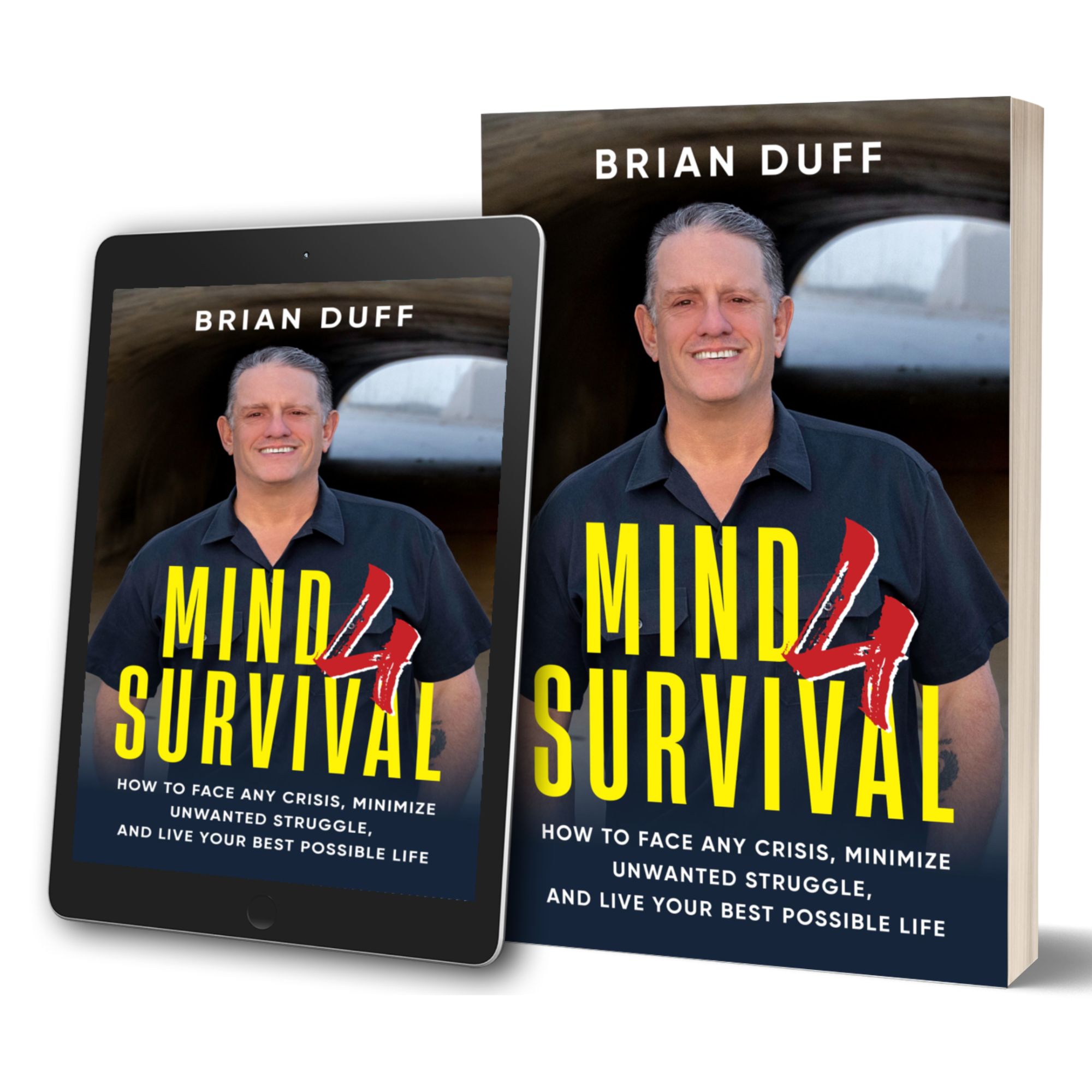
Mind4Survival: How to Face Any Crisis, Minimize Unwanted Struggle, and Live Your Best Possible Life
The whole framework in one place—mindset, situational awareness, survival, safety, and self. Written to help you face any crisis, minimize unwanted struggle, and live your best possible life.
Get the BookThe Bottom Line About PTSD
PTSD is a system. An experience produced a response, and repetition wore that response into a pattern.
Systems can be hacked. The intensity comes down. The pathways rewire. It takes real treatment and it takes time, and the only thing it truly requires from you is the willingness to start.
You are not weak. You are not broken forever. You are not the only one—not by a long way.
I was at the top of my profession when I hit bottom. I got help. I did the work. I'm still doing it. And the man writing this can drive through the desert now.
You can get your life back. Go get it.
If this hit home, tell me in the comments. Somebody else reading it needs to know they're not alone.
Stay safe,

PTSD FAQ
They fall into three clusters. Re-experiencing covers intrusive memories, distressing dreams, flashbacks, distress at reminders, and physical reactions. Avoidance and numbing covers avoiding reminders, memory gaps, lost interest, detachment, flat affect, and a foreshortened sense of future. Hyperarousal covers sleep trouble, irritability, poor concentration, hypervigilance, and an exaggerated startle response.
PTSD is highly treatable, and the majority of people who get real treatment improve significantly. EMDR, prolonged exposure, and cognitive processing therapy all have strong evidence behind them. Trauma is a system, and systems can be changed. Recovery takes work and time, but it is possible.
No, and confusing them causes real harm. Situational awareness is a trained skill you dial up and down as a situation calls for it. Hypervigilance is a PTSD symptom that runs whether you want it to or not, and it burns you out. One is control. The other is a nervous system stuck on.
No. Trauma does not discriminate, and combat is only one road in. The highest PTSD rates follow sexual assault, severe violence, and childhood abuse. Serious accident survivors, people who lose someone suddenly, and disaster victims develop it as well. You do not need a uniform to carry it.
Talk to a doctor or a licensed therapist, and ask specifically about trauma-focused treatment like EMDR or cognitive processing therapy. If you are a veteran, the VA has dedicated PTSD programs. If you are in crisis right now, call or text 988. Getting help is a strength move, not a weakness.
The Mindset & Recovery Library
Thirty articles, organized the way recovery actually goes—understand it, manage it, break the patterns, come back stronger.
PTSD and Trauma
- 01What Is Post Traumatic Stress Disorder (My PTSD Battle)→
- 02What Are the 17 Symptoms of PTSD You Should Know?→
- 03Right of Bang: Surviving the PTSD Aftermath of Crisis→
- 04Coping and Managing Stress with PTSD→
- 05The Unseen Enemy: Navigating Emotional Trauma→
- 06Grief as a Force Multiplier→
- 07Why Veterans Make Excellent Preppers→
Day To Day
The Mindset Underneath
- 14Build a Resilient Mindset for Uncertain Times→
- 15Mental Fortitude: 7 Steps to Develop Mental Toughness→
- 16The Ranger Mindset: Don't Quit When It Gets Hard→
- 17Survival Mindset: How to Succeed When It All Falls Apart→
- 18SHTF Mindset: How to Think When Everything Fails→
- 19All About Disaster Mindset→
- 20Preparedness Training to Develop Your Mindset→
- 21How to Cultivate Your Prepper Mentality→
Thinking That Holds You Back
Life After
Keep Going
New episodes twice a week. Mindset, situational awareness, survival, safety, and self—the five fundamentals, every week.