
Situational Awareness: The Complete Guide to Seeing Trouble First
TL;DR—Situational awareness is your ability to detect what's happening around you, understand what it means, and project where it's headed. It's the Observe and Orient half of the OODA Loop, and it runs on one thing: detecting a change in your situational baseline. Learn your normal, notice the shift, and you buy yourself time to decide well.
Most bad outcomes don't come out of nowhere.
The car that "appeared from nowhere" didn't materialize out of thin air. The curb that tripped you didn't pop out of a hole. And if we'd paid attention to that knot in our gut, we probably would have avoided the thing we still kick ourselves over once in a while.
Pull the thread on most problems and you find the same root cause. Somebody didn't notice in time to do anything about it.
That ability to notice—to read what's happening in your personal environment, understand it, and act before it's too late—is situational awareness. After mindset, it's the most important fundamental of preparedness there is.
Here's the good news up front. Situational awareness is a learnable skill, not a paranoia-driven personality trait. It costs nothing. It requires no gear. If you've ever had that "something's not right here" feeling and trusted it, you already have the instinct. The work is sharpening it into a tool you can rely on without having to think about it.
What Is Situational Awareness?
Situational awareness is your ability to detect and understand what's happening in your personal environment—right now and in the near future—and to feed that understanding into the decisions you make and the actions you take.
Dr. Mica Endsley, a former Chief Scientist of the U.S. Air Force, gave the field the definition it still leans on. Situational awareness is the perception of the elements in the environment within a volume of time and space, the comprehension of their meaning, and the projection of their status in the near future.
Strip out the academic language and it's simple. Your senses take in information as you go about your day. Your mind runs that information through a filter of your experience, biases, and beliefs. What comes out the other side is your understanding of your situation—your perspective.
That understanding, right or wrong or somewhere in between, is what every decision you make gets built on.
Order matters here. Mindset is how you approach the world. Situational awareness is how you read it. Everything downstream—safety, survival, protecting the people you love—depends on whether you noticed the problem in the first place.
Why Situational Awareness Matters
If you don't detect a change in your environment, your brain assumes nothing changed. So you keep operating like everything's fine.
- The man walking with his head down, thumbs flying across his phone, doesn't see the ankle-breaking hole in the sidewalk.
- The distracted parent at the park misses the guy who's been watching her kid for ten minutes.
- Nobody reads the report of unrest in the city where their daughter is traveling this week.
You can't avoid a threat you never perceived. And you can't take an opportunity you never spotted.
Situational Opportunity
That second half is what most "stay alert" advice skips.
Awareness isn't only about danger. The same skill that helps you notice a bad stairwell in a parking garage helps you notice the open seat, the shorter line, the friend across the room, the deal about to expire. Good awareness makes your ordinary Tuesday run smoother, not just your worst day.
I call that situational opportunity, and it's the Mind4Survival philosophy in one idea. This is not about fear.
Being situationally aware is not being paranoid. It's rational, logical preparedness. The goal of awareness is the same as the goal of all prepping—keep your life as normal, as stress-free, and as good as possible, for as long as possible, no matter what's happening around you.
For where this shows up most in daily life, see Everyday Situational Awareness: 5 Risky Situations.
Situational Awareness Is Only Half the OODA Loop
Here's a misunderstanding I run into constantly. People think the OODA Loop is situational awareness. It isn't.
Colonel John Boyd, the fighter pilot and strategist, built the OODA Loop as a decision-making model: Observe, Orient, Decide, Act. The key point is the split.
| Phase | Half | What Happens |
|---|---|---|
| Observe | Situational Awareness | Take in everything you can through your senses, and through your subconscious. This is where you perceive the true reality of your personal environment. If you don't detect it, you can't respond to it. |
| Orient | Situational Awareness | Make sense of what you observed by running it through your experience, knowledge, and biases. Orient is where perspective gets built, for better or worse. Garbage in, garbage out—if your orientation is off, every decision after it inherits the error. |
| Decide | Decision-Making | Choose a course of action based on your understanding of the situation and how it relates to you. |
| Act | Decision-Making | Execute. Monitoring an unfolding event is a legitimate action. So is pausing to let a situation develop. |
The Mind4Survival process is built on Boyd's loop, with Endsley's definition and Jeff Cooper's Color Code layered in. What it adds is a look inside each phase, so that when you get stuck you can find exactly where the holdup is.

For the deeper mechanics, read Master the OODA Loop. For what happens when a real emergency compresses the loop, see SHTF Is Inside Your OODA Loop.
Observe: Objective Reality vs. Your Perception
There is always one—and only one—true objective reality.
Your perception of it is something else entirely. Your view sits at least one degree removed from what's actually there, because of the human condition and because of you specifically.
Perception falls on a bell curve. A few of your perceptions are dead right. A few are dead wrong. Most land somewhere in the middle, partly right and partly wrong. That middle is where the work is.
The goal isn't perfection. The goal is holding your observations as close to true reality as you can, so the decisions built on top of them start from solid ground.
Observe: Your Situational Baseline
This is the engine room of situational awareness, and it's the part almost nobody explains.
Your situational baseline is the normal hum of your personal environment—the situational homeostasis. Right now, as you read this, your baseline is calm. Nothing has changed in the last two seconds, so you feel safe. And you'll keep feeling safe until something shifts it.
That stability is a gift. It's what lets you enjoy a quiet evening, a drink, and a good book without scanning the room every five seconds.
Awareness is simply detecting a change in that baseline—what I call a change of state.
A change isn't automatically bad. The new element could be harmless, helpful, or dangerous. Good, bad, or indifferent doesn't matter at this stage. What matters is that you notice it. No detection means no information, and no information means no decision to make.
If you don't detect it, it isn't in your reality yet. Think of a stranger walking up behind you that you haven't noticed. He's real. He's there for a reason. But until you detect him, he doesn't exist in your perceived world.
The Two Ways You Detect Change
You detect a change of state two ways.
External Stimuli—Your Five Senses
Your classic senses feed your conscious mind.
- Do you see something?
- Do you hear something?
- Do you smell, feel, or taste something that says your situation shifted?
Straightforward, and mostly what people mean when they talk about awareness.
Internal Stimuli—Your Sixth Sense
This is the one people throw away.
Your subconscious runs 24/7/365. Even when your conscious mind is asleep, daydreaming, or checked out, your subconscious keeps working. It ties the present moment to every significant experience of your life and alerts you through physical sensation when something matches.
The hair standing up on the back of your neck. The knot in your stomach. That feeling that something is off before you can name it.
It works on the good side too. When your subconscious spots an opportunity, it sends comfortable sensations—sometimes all the way up to excitement.
Here's the catch: your subconscious doesn't always get it right. It's pattern-matching against your past, and it can't always tell the difference between a real problem now and something that hurt you before. That's especially true if you're carrying trauma. The alert feels identical either way.
So when your gut pings you, don't dismiss it and don't obey it blindly. Check in. Is this real, or is it an old pattern firing? Sometimes it's a false alarm. Sometimes it's the most important data you'll get all day. Learning to tell the difference, and taking it seriously either way, is one of the highest-payoff awareness skills there is.
Most people assume their conscious mind runs the whole show. It doesn't. Writing off the one part of your mind that never clocks out means throwing away your best sensor.
If your alarm system is running hot for reasons you already understand, Right of Bang: Surviving the PTSD Aftermath of Crisis and Coping and Managing Stress with PTSD are where to start.
Observational Capability: Mindset, Ability, and Luck
Whether you detect the change of state at all comes down to your observational capability, and it has three parts.
- Mindset. Are you present enough to notice? Head up, or head down in your phone?
- Ability. Do you have the knowledge, skills, and resources to recognize what you're looking at?
- Luck. Sometimes a sound bounces the right way. Sometimes it doesn't.
Two of those three are yours to control. Mindset and ability are trainable. Luck is not.
You work the parts you own.
Cooper's Colors: Your Awareness Dial
People ask whether being aware means living on edge, always braced for the worst. No.
You can't stay on high alert all the time, and you shouldn't try. It's exhausting, it isn't an enjoyable way to live, and it burns you out. The skill is moving deliberately between levels of alertness as the situation calls for it.
The best tool for that is Cooper's Colors, from the late USMC Lieutenant Colonel Jeff Cooper.
| Level | Condition | What It Looks Like |
|---|---|---|
| White | Switched off | Oblivious, head down, lost in thought, unprepared to react. This is the phone-scrolling-in-the-parking-lot state. Spend as little of your public life here as you can. |
| Yellow | Relaxed awareness | Calm and comfortable, but tuned in. You'd notice if something changed. This is where you want to live in public, and it adds no stress. It's roughly where you are right now, reading this. |
| Orange | Specific alert | Something got your attention. Most of your focus shifts to that one thing while you size it up. |
| Red | Ready to act | You've identified it and you're prepared to do something about it now. This is the mother who puts herself between her baby and an oncoming car. |
| Black | Overload | A later addition Cooper himself didn't endorse. This is your central nervous system hijacking your rational mind in a freeze, flight, or fight response. |
The colors matter less than the idea behind them. Your awareness moves, and you can move it. Live in white at home. Operate in yellow in public. Dial up to orange and red when the situation earns it, then deliberately dial back down.
When black hits and you lock up, that's a specific and trainable problem. Freeze Response: Why You Get Stuck and What to Do covers the way out.
Best Seller
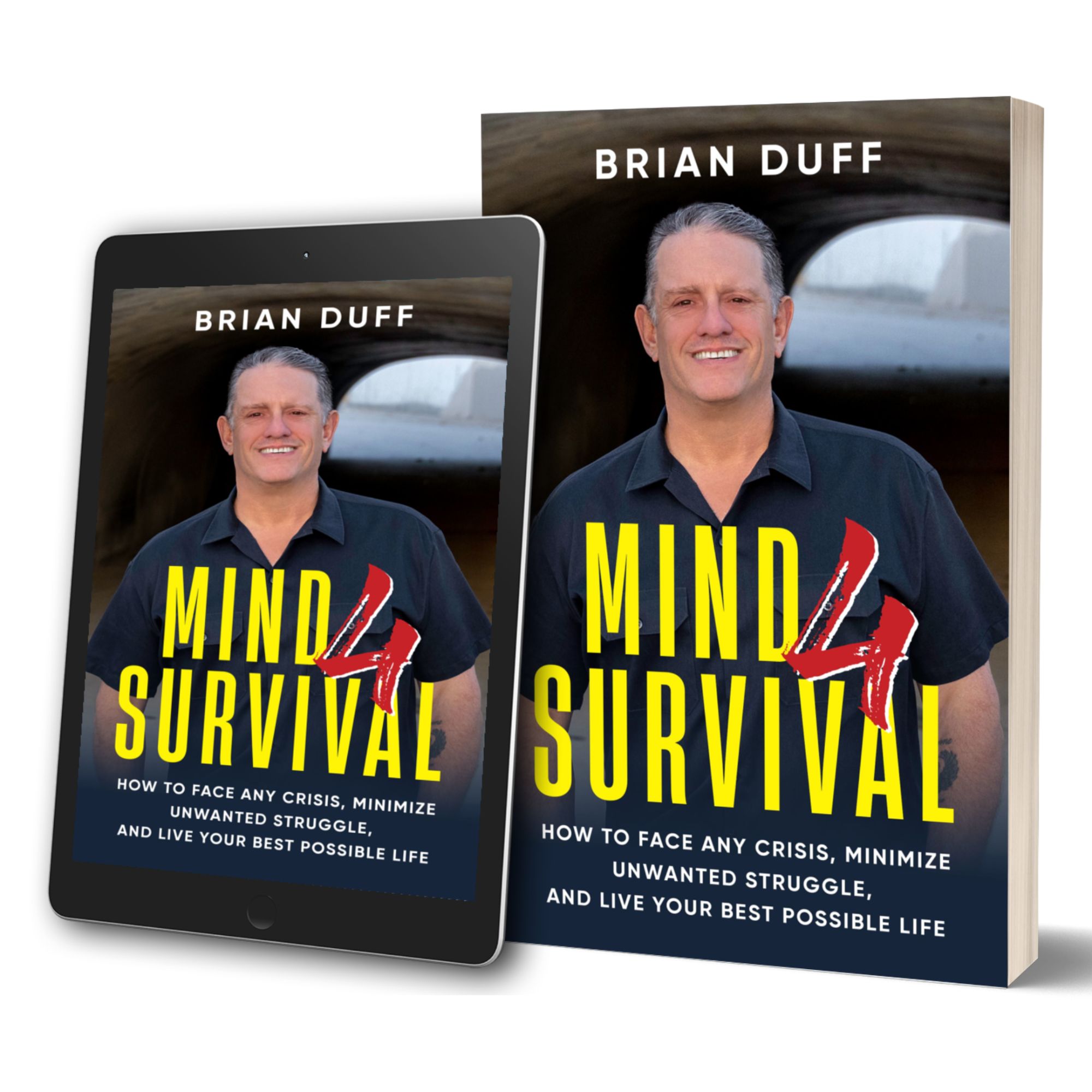
Mind4Survival: How to Face Any Crisis, Minimize Unwanted Struggle, and Live Your Best Possible Life
Situational awareness gets its own chapter in the Amazon best seller, where I walk through the full decision-making process, the baseline, and the four steps—with the stories behind how I learned them the hard way.
Get the BookOrient: Where Perspective Gets Built
Once you've gathered what you can perceive, you orient.
This is where you run the observed data through the filter of your human nature and lived experience. You pile every good lesson you've learned, along with every bias you've been carrying around, on top of objective reality. What comes out is your perspective.
You and I can look at the same man standing in a driveway. I see a trespasser. You see the new neighbor you've been meaning to meet. Same man, same driveway, two different realities.
Decisions are a string of opinions you believe to be true. Which makes your perspective the input, not a side issue.
Endsley's definition maps onto three levels here.
Level 1—Perception: What's Happening
Raw input. What you see, hear, smell, feel, and sense. The car drifting in its lane. The change in someone's voice. The chained handles on the emergency exit near the bathroom.
Level 2—Comprehension: What It Means
Connecting the dots. What you observed, how it relates to you, how it relates to everything around it, right now. A man in a driveway is just a man in a driveway until you remember watching him move in this morning.
Level 3—Projection: What Happens Next
The highest level and the biggest payoff. If that car keeps drifting, it's in my lane in two seconds. If this crowd keeps moving this way, it bottlenecks at the exit.
Projection buys you time. You respond to what's about to happen instead of what already did.
This is also where things break. Your biases live in Orient, and they will rewrite what you saw without asking permission. 7 Cognitive Biases That Destroy Your Situational Awareness names the worst offenders. Train Your Mind to Overcome Normalcy Bias covers the one that gets people hurt. Is Your Perspective in Preparedness Putting You at Risk? is the self-audit.
Decide: Keep Your Nervous System Out of the Driver's Seat
Decide and Act are not situational awareness. They're what awareness is for, so we follow it through.
Every time you make a decision under a perceived threat, you risk your central nervous system hijacking the process. It hands you three options—freeze, flight, or fight—and it does it based on your perception of the data from Orient, not the facts.
An emotional response isn't automatically bad. Sometimes it just makes you decide faster than you otherwise would. The skill is recognizing when it's an ineffective response and adjusting.
The first milestone of good decision-making is this: don't enter the decision riding a wave of nervous system response. The more emotion in the process, the more room there is for a poor decision.
The Four-Step Decision Process
When you get stuck, fall back on this. It starts back in Orient.
1. Analyze the information
Does this line up with what I know and what I value? Where did it come from? Can I trust the source? Have I challenged my own perspective?
2. Identify the problem—or not
Is this actually a problem to solve, an opportunity to take, or nothing at all? Has my risk profile changed?
3. Develop options
Does this even require a decision right now, or can it wait? Build a few paths with a P.A.C.E.S. plan—Primary, Alternate, Contingency, Emergency, SHTF.
4. Choose your best option
Pick it and go. A quick SWOT check—strengths, weaknesses, opportunities, threats—helps when you have time. When you don't, go with your gut.
For the wider frame, Risk Management: How to Manage Risks Made Easy and How to Create a Risk Profile do the heavy lifting.
Act: Four Outcomes
Your decision comes out as one of four actions.
- A central nervous system response. Freeze, fight, or flight—an emotional reaction that bypasses your decision-making.
- Intentional action. You worked the process, and you're doing something about it.
- Gather more information. You need more before you commit, so you monitor.
- Review past actions. You look at what worked before, for you or for someone else, and use it.
Those last two look like inaction. They aren't. Letting a situation develop while you gather information is a decision, and it's often the right one.
Which brings me to the line I keep coming back to.
How to Improve Your Situational Awareness
Awareness is trainable. Here's how you train it.
1. Default to Yellow in Public
What—Relaxed awareness as your standing condition outside the house.
How—Head up. Phone away when you're moving through the world.
When—Every time you leave your car, your house, or your desk.
You're not hunting for threats. You're just present in your own life.
2. Learn Your Baselines
What—The normal hum of the places you spend time.
How—Pay attention to normal on purpose. Energy level, foot traffic, noise, who's usually there.
When—Anywhere you go more than once.
Awareness is change detection, and you can't detect a change from a normal you never learned. 7 Practical Tips to Build Situational Awareness has more drills.
3. Run the "What's My Exit?" Habit
What—A quick read of every new space.
How—Walking in, note the exits and where you'd go if you had to move fast.
When—Restaurants, stores, lobbies, hotels, venues.
Do it consciously for a few weeks and it goes automatic.
4. Trust Your Gut, Then Verify
What—Taking your internal alerts seriously without obeying them blindly.
How—When something feels off, act on it enough to look into it. Move. Turn. Create distance. Get a better angle.
When—Every time your body pings you.
It might be nothing this time. It won't be nothing every time.
5. Manage Your Inputs
What—Protecting the sensors you're relying on.
How—Watch what fatigue, alcohol, stress, and a phone habit are doing to your attention.
When—Decide in advance when you're going to check out, and stay mildly locked in the rest of the time.
You can't be aware if you've sandbagged your own senses. The flood of information coming at you counts too—Breaking Free From Information Fatigue Syndrome is worth your time.
Key Terms, Defined
Five terms do the heavy lifting in the Mind4Survival approach to situational awareness. Here they are in one place.
- Situational Awareness
- Situational awareness is your ability to detect and understand what's happening in your personal environment, right now and in the near future, and to feed that understanding into the decisions you make and the actions you take.
- Situational Baseline
- Your situational baseline is the normal hum of your personal environment: its situational homeostasis. The usual energy of your coffee shop, the usual foot traffic on your street, the usual sound of your house at night.
- Change of State
- A change of state is a detected shift in your situational baseline. It is the whole of awareness. The change can be good, bad, or indifferent. What matters is that you notice it, because no detection means no information, and no information means no decision to make.
- Situational Opportunity
- Situational opportunity is the upside of awareness. The same skill that helps you spot a bad stairwell helps you spot the open seat, the shorter line, and the deal about to expire. Awareness makes your ordinary Tuesday run better, not just your worst day.
- Observational Capability
- Observational capability determines whether you detect a change of state at all. It has three parts: mindset, ability, and luck. Mindset multiplied by ability equals capability. Luck is the third factor, and it is the one you do not control.
The Bottom Line About Situational Awareness
Situational awareness is the skill of seeing trouble and opportunity before they reach you.
It's perception, comprehension, and projection. It runs through the Observe and Orient phases of your OODA Loop. You scale it with Cooper's Colors. And it all rests on knowing your baseline and taking your gut seriously.
You don't have to be paranoid. You don't have to live on high alert. You have to be present.
Default to yellow. Learn your baselines. Look up from your phone. When something feels off, check it out. Be intentional about it.
Do that, and you'll spend a lot more of your life ahead of the curve instead of reacting to it.
What's the one thing you notice now that you used to walk right past? Tell me in the comments.
Stay safe,

Situational Awareness FAQ
Situational awareness is noticing what is happening around you, understanding what it means, and predicting what is likely to happen next, early enough to make a good decision and act on it. Perceive, comprehend, project. It applies to spotting opportunities just as much as it applies to avoiding trouble.
Perception, comprehension, and projection. Perception is what you detect through your senses. Comprehension is what it means for you and your situation. Projection is where it is headed next. They build in order, so a gap at a lower level breaks every level above it.
Your situational baseline is the normal hum of a place: its usual energy, foot traffic, noise, and who is usually there. Awareness is detecting a change in that baseline, what Brian Duff calls a change of state. You cannot detect a change from a normal you never learned.
Cooper's Colors are Jeff Cooper's five levels of awareness. White is switched off. Yellow is relaxed awareness, where you want to live in public. Orange is a specific alert. Red is ready to act. Black is overload, a later addition Cooper did not endorse. Your awareness moves, and you can move it.
Situational awareness is the first half of John Boyd's OODA Loop, the Observe and Orient phases. Decide and Act are the decision-making half that follows. The loop is a decision-making model, not an awareness cycle, and confusing the two is the most common mistake people make with it.
Yes. It is a skill, not a trait. Default to Condition Yellow in public, learn the normal baseline of the places you spend time, scan exits when you enter a new space, take your gut alerts seriously, and protect your attention from fatigue and distraction. It costs nothing but attention.
No. Paranoia is fear without a basis, and it wears people down. Situational awareness is calm, relaxed attention that you scale up only when something warrants it, then dial back down. Done right, it lowers your anxiety, because you trust yourself to notice what matters.
The Situational Awareness Library
Thirty articles, organized the way the skill actually works—observe, orient, then decide and act.
What It Is, And How To See It
- Situational Awareness: The Skill That Could Save Your Life
- Situational Awareness: Staying Alert and Staying Safe
- What Is Readiness? A Calm, Rational, Prepared State of Mind
- The Lost Art of Paying Close Attention to Your Situation
- How to Increase Your Everyday Situational Awareness
- Everyday Situational Awareness: 5 Risky Situations
Build The Skill
- How to Practice Situational Awareness in Daily Life
- 7 Practical Tips to Build Situational Awareness
- 5 Situational Awareness Tips to Help You Become More Alert
- Situational Awareness Training: Are You Really Prepared?
- Situational Awareness Reset (Do This Everywhere)
- Pressure-Test Your Plan: 8 Weekend Survival Drills
The Filter, And What Distorts It
- Master the OODA Loop: Boost Your Situational Awareness Today
- SHTF Is Inside Your OODA Loop: What Do You Do?
- 7 Cognitive Biases That Destroy Your Situational Awareness
- Train Your Mind to Overcome Normalcy Bias
- Freeze Response: Why You Get Stuck and What to Do
- Is Your Perspective in Preparedness Putting You at Risk?
- Why Most Preppers Miss the Real Threats
- How to Get Inside a Criminal Mind to Stop a Bad Guy
Turn Awareness Into Decisions
Awareness In The Real World
Keep Going
New episodes twice a week. Mindset, situational awareness, survival, safety, and self—the five fundamentals, every week.