
Prepping on a Budget: Thought Over Emotion
Podcast: Play in new window | Download
Money is one of the most common reasons people give for not prepping. When I asked Mind4Survival readers what holds them back from their preparedness goals, more than 460 people answered, and money came up in 166 of those answers.
It usually sounds something like this: “I can't afford a generator right now,” “I can't drop $1,000 on food buckets,” or “I'll start when things settle down financially.” Each of those is a valid reason when the money isn't there, and I've been there myself, but each one assumes that preparedness begins with a purchase, and it doesn't.
Most of what makes a person prepared costs nothing. You can work on your mindset and your knowledge for free, and your skills build as you practice them. The resources you have to buy are doable over time, even on a tight budget, when you buy in an effective, planned, and systematic way. The people who prep with the least wasted money are the ones who buy based on thought instead of emotion, because decisions made in a fight, flight, or freeze state are more likely to be poor ones.
TL;DR: Prepping on a budget starts with free steps. Learn about a problem before buying a solution, build a buy list from your risk profile, and inventory what you already own. Set a monthly prepping budget, even $25, and avoid debt. Save cash as a prep, rank purchases by what each dollar returns, and stock food your household already eats, bought on sale.
Knowledge Protects Every Dollar You Spend
Knowledge is one of the least expensive preps there is, and it helps protect every dollar you spend. Money spent before you understand the problem or the solution is more likely to be wasted.
The Dunning-Kruger effect, which I cover in my book Mind4Survival, describes how people who know very little about a subject tend to think they know more than anyone else. For prepping, that means learning about the problem before you buy the solution.
Members of the Mind4Survival Facebook group have described buying inverters that couldn't handle the load they needed, judging food buckets by servings rather than calories, and stocking canned goods nobody in the house wanted to eat.
Gaining knowledge costs nothing. Before you buy anything, read about it, watch someone use it, and ask people who own one, since there is likely a Facebook group for whatever you're thinking about buying. When you do that, your money goes toward the right item at an informed price.
Plan First, Then Spend
People who buy without a plan, and I've done it myself, are more likely to make emotional purchases that end in a stack of gear that goes unused and sometimes unopened. They're also more likely to overspend and go into debt over prepping. With some credit cards charging 30% interest, that debt gets expensive quickly.
Debt taken on for unplanned purchases often goes to items you don't need before items you do. If you haven't worked on your risk profile, I went over it in How to Prep Despite the Overwhelm.
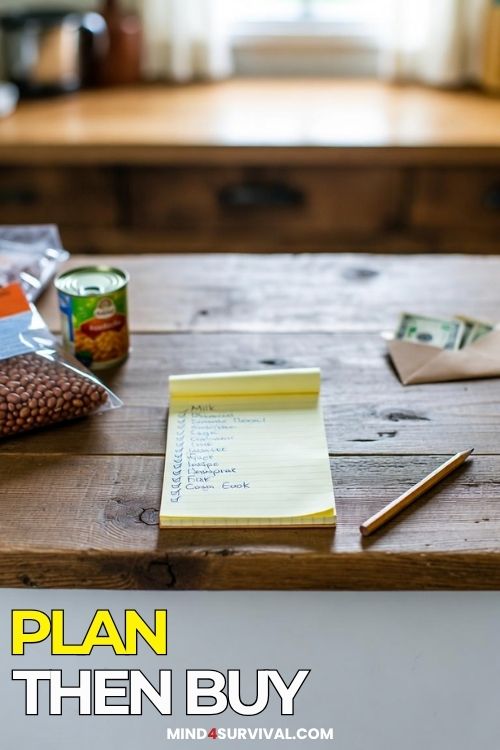
The plan: For each asset at risk, such as your family, house, vehicle, dog, or preps, write down what you need to mitigate or avoid each threat and address your vulnerabilities. Then write down what you need to minimize the aftermath if the threat isn't avoided. Do that for every asset and every risk in your risk register, because one asset may face several threats. The resulting list is where you should focus your time, effort, and money.
Why it works: The list changes “I should just go buy something” into “I need this specific item for this specific reason,” and emotional purchases usually don't meet that standard. If a full risk profile feels like too much right now, sit down and list what you think your greatest threats are.
Inventory What You Already Own
Most households already have more preps than they realize, and taking inventory costs nothing.
Walk through every room with a notepad and list anything that addresses part of your risk profile. The water heater holding 40 gallons is a water source, and the old camp stove in the garage is a backup way to cook and purify water. The flashlights spread across three or more drawers count, as do the first-aid supplies scattered across two bathrooms.
Heather in the Mind4Survival Facebook group wanted a first-aid kit for her car. Her son pointed out that she already had everything for it at home, and it just needed to be packed together, so she bought an empty med bag and filled it herself.
Consolidate what you find. Write down what's expired or missing, and then compare what you have against your list. What's left is the actual gap in your preparedness supplies, and it's usually shorter and less expensive than the one we build in our heads. Taking inventory also keeps you from buying something you forgot you already owned, which I've done more than a few times.
Know Your Budget and Stick to It
You can't stick to a prepping budget you haven't set. Look at your income and fixed expenses, decide what's left after necessities and savings, and write down a monthly prepping budget that makes sense for your household, even if it's $20 or $25. That number becomes a line item in the household budget, the same as groceries or fuel.
Keep three rules in mind:
- Avoid debt for preps. Going into debt due to a lack of funds is a choice that may cause problems over the long term.
- Needs over wants. The list you built from your risk profile tells you which is which.
- Stick to the budget. Hold to the number you set.
Bernie Carr's One Year of Prepping: $25 a Month shows what that monthly number can accomplish over twelve months.
Cash Counts as a Prep
Savings belong on your list beside water and food. Job loss, a medical bill, a car repair, and a hotel stay during a storm evacuation are all solved with money, and an emergency fund covers most risks on your profile at once. Ready.gov also has guidance on financial preparedness.
Most emergencies don't create a situation where cash stops working; after Hurricane Helene, systems were set up and operating right away.
One group member who rebuilt her preps from nothing said she bought too much too fast. When COVID hit, she found that a healthy savings account would have served her better than a lot of what she had stockpiled on her shelves.
Budget a cash reserve alongside your monthly prepping budget, not after it, because it is a prep. Overbalancing supplies against cash on hand is a common mistake. Cash also lets you act when a secondhand item in like-new condition comes up on the local market at a good price. When economic times get hard, many people sell their belongings to make ends meet.
Prioritize What Each Dollar Returns
With your list built and your budget set, priority decides what gets bought first, and the deciding factor is what each dollar returns in capability.
Some purchases cover more of your risk profile by addressing several assets and several risks, so they cost less for the coverage they provide. A good water filter with replacement cartridges covers long-term needs and may be a better use of money than buying cases of water every week. If cash is tight, a $10 multi-purpose tarp covers the shelter gap while you save for the $100 tent you want.
Timing matters too, since a seasonal sale, a used tool at auction, or a bulk price can move an item up the list this month and back down the next. Amazon's sales, including those around Cyber Monday, sometimes discount solar gear and batteries by a third or more.
There is no one-size-fits-all order. Rank your list by the effectiveness of each dollar against your own risks and take advantage of price and timing when they line up. When in doubt, use the Survival Pyramid to guide the decision and buy the items that save life the fastest or sustain it the longest first.
Buy What You Eat, Buy It on Sale
Food is where a lot of prepping money goes, and where a lot of it gets wasted when it isn't eaten. Four rules help prevent that.
Buy what your household already eats. Pick up one or two extra of each item per grocery trip, and the stockpile grows over time. Rotate it first in, first out, so the oldest food gets eaten first. For more, see how to build a food stockpile on a budget.
Buy on sale. Learn the sale cycles at your regular stores and stock up on staples when prices drop, not when the pantry is empty.
Judge long-term food by calories per dollar, not servings per bucket. A serving count tells you nothing about how long the food will last a working adult. During a disaster, when you're stressed and physically exerting yourself, plan on about 3,000 calories a day for a man, possibly 3,400, and 2,600 to 3,000 for an average woman, with variation by age. A bucket with 10 servings won't last three days if it takes four servings to fill you up.
Skip the freeze-dried buckets until your everyday pantry is stocked. Pantry staples such as canned foods and pasta usually keep upwards of two to five years, and canned food sometimes keeps longer.
A pantry built from sale-priced food you already eat saves money even if nothing ever goes wrong. For more, see Best Foods to Stockpile for an Emergency Food Supply.
What the Community Says
I asked the Mind4Survival Facebook group how they budget for prepping without straining their monthly finances. Some members start small, with a can of soup or a package of bandages, and then redirect the money they would have spent on impulse buys toward larger purchases. Others set aside a fixed amount from each paycheck and check with a spouse before going over it, or use only cash for preps so money that isn't in the wallet can't be spent. One member raises extra money by selling scrap metal.
Members also cut costs in other areas by buying routine consumables in bulk on sale, using the public library instead of buying books, simplifying meals, gardening and preserving food, and no longer eating out. One member pointed out that there's no use spending money you need for food now on preps you may or may not need in the next year.
The Bottom Line
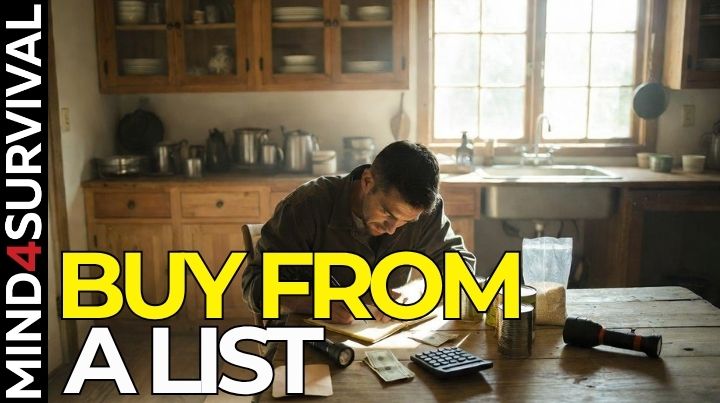
Money is a real constraint that sets the pace of your prepping, but it doesn't decide whether you can start. Learn about the situation and the item before you buy, build your list from your risk profile, inventory what you already own, set a monthly budget and stick to it, and put cash on the list. Rank purchases by what each dollar does for you, and buy the food you already eat when it's on sale. All of it takes a notepad, a budget, and the discipline to buy from a list instead of a feeling.
Financial times are hard right now, and some people are struggling more than others, but preppers are resilient, and you can do this.
Additional Resources
- Prepping With No Money
- One Year of Prepping: $25 a Month
- Best Foods to Stockpile for an Emergency Food Supply
- Prepping on a Budget: Thought Over Emotion
FAQ
Yes. Knowledge, planning, inventory, and skills practice cost nothing. Most households already own a week of food, water in the heater, and a few flashlights. Consolidating and organizing what you have is real preparedness, and it's free. More in Prepping With No Money.
Whatever is left after necessities and savings, written down and held. $25 a month builds a 14-day kit in a year. The number matters less than holding it every month.
Not first. Build a deep pantry of shelf-stable food you already eat, bought on sale. Add freeze-dried later if your risk profile calls for it, and judge it by calories per dollar.
No. Debt creates the financial struggle you're preparing to avoid. If a prep can't be bought with cash this month, it waits.
Yes. Cash solves job loss, medical bills, and evacuations faster than gear does, and it covers most risks on your profile at once. Fund it alongside your supplies, not after.
Related Articles
FREE Guide
Read the Best Seller

Join Mind4Survival
Stay informed by joining the Mind4Survival! 100% Secure! 0% Spam!

Affiliate Disclosure...
Mind4Survival is a free, reader-supported information resource. If you make a purchase through our link, we may, at no cost to you, receive an affiliate commission.
Do You Want To Be Ready No Matter What?
Download our free 39-page guide with interactive, 7-Day Emergency Kit Checklist and take the first step toward real preparedness.
- Know exactly where to start.
- Save time and money.
- How-to build a complete Basic Emergency Kit.
- Level up your safety and security.

Join Mind4Survival
Stay informed by joining the Mind4Survival! 100% Secure! 0% Spam!